Showing posts with label Homeschool. Show all posts

Monday, August 24, 2015

Teaching Sewing in Our Homeschool

We follow the Charlotte Mason method of homeschooling which includes doing Handicrafts.  My girls chose sewing as their handicrafts for this term of school.  To begin with, we are going to use this free Craftsy video on Sewing Machine Basics.  It includes printables to go along with the video tutorial. 
Then we are going to use these tutorials from www.schneiderpeeps.com.
Make a Felt Needle Book
Make a Pincushion
Make a Doll Quilt
Pillowcase Dress

I am pretty sure my 8 yr old will be able to improve in her skills enough to make the Doll Quilt but I think the 6 yr old will need a lot of help or I will have to find a much simpler project for her.  She really wants to learn to use the sewing machine though.  So we will do the needle book and the pincushion and see where we are from there.  I might preview this reversible tote class and see if I think she could handle it, when it gets to that time.

I am super excited to get started with them!  I put together little sewing kits for them and can't wait to pass them out!

How did you learn how to sew?  Do you still sew today?

Wednesday, October 1, 2014

Nervous about teaching math?

Need some advice when it comes to teaching math?  Me too.
Math is an intimidating subject for me. So for this article I decided to seek out the advice of those around me who have more experience and I am sharing it with you!  And while I think that this information will be helpful, I would encourage you to do some research for yourself as well.  If you have concerns about a certain subject it can be really helpful to talk about it and learn from others...

To read more, check out the most recent edition of  Homeschool.com's Digital Magazine.


Tuesday, August 26, 2014

Review: Supercharged Science e-Science Curriculum


 If you are looking for a complete, hands-on Science curriculum that has been thoroughly tested and proven to be effective and fun, then I would suggest Supercharged Science e-Science Curriculum!
It is put together by Aurora Lipper who has spent many years teaching it in public school, college and home settings.  She is committed to quality education, thus the projects aren't watered down but are clearly presented in a way that will have you and your child feeling, thinking and acting like a real scientist!

"With over 900 science activities, experiments and projects spanning pre-kindergarten to high school, thousands of pages of lesson plans, data lab sheets, quizzes, exercises, and reading material, and an unlimited number of questions kids can ask, your children always have something new and exciting to learn from on the e-Science program! You’ll find real videos of real scientists in action, taking you step-by-step through the entire learning process. You won’t believe how much kids can have while learning science."

Format
The curriculum consists of over 900 hands-on Science lessons and activities with instructional step-by-step videos that any K-12th grade student can follow.  There are lists of supplies needed and written instructions for most experiments as well.


Cost
Enrollment in the full online e-Science program is just $1 for the first month. After the first month, you will automatically be charged just $37(K-8) or $57 (K-12) per month as long as you are enrolled. You also get a DVD with 10 science lessons mailed to you when you try e-Science.
Enrollment is month-by-month so you can customize it for when you need it.
For more info, read the FAQ.
*Free-
To get an idea of what the program is like you can Enter Your E-Mail to receive a 
Science Experiment Guide
Over 30 easy-but cool science activities

Materials Needed
Subscription
Most supplies are easily found in your own home, Grocery store or at a Hardware store.

How We Use It
I was given a membership to Supercharged Science e-Science Curriculum for this review and in order to use it in our local homeschool co-op.  I am planning to use it to teach a group of 3rd-5th graders.  One of the great things about using this curriculum is that it is possible to use it with multiple ages at once!  We are going to learn about keeping a Scientific Journal, how to use the Scientific Method and spend 10 weeks completing experiments that will facilitate learning more about the systems of the atmosphere and weather. 
-Scientific  Journals:  I am excited to introduce the Scientific Journals.  I think that, besides being fun, they will be a great learning tool and a great way to record the work the children have done and what they have learned.  All you need is a simple notebook and Aurora explains how to use it.
-Learning Scientific Method: I also love that Aurora lays out how to go about conducting the experiments using the Scientific Method.  And not just by telling you, but by having you conduct an experiment and walking you through the Scientific Method as you work.

What We Think
I really can't say for sure what I think of this curriculum as I haven't had a chance to put it into action.  But in my planning I have watched the videos and gathered supplies and I have only been impressed with the quality and clarity thus far.  Because of this, I am super excited to share this program with the kids at co-op and I will be sharing updates as we go along.  So if you want to wait and see how it goes, then check back in September!


"They will not only excel in science education, but have an extraordinary foundation to stand on when they hit college. Start your children on the road to success and help them become more confident students. You’ll appreciate that Supercharged Science helps you track your children’s progress through their science journals so you can keep up with them every step of the way. Watch and be amazed as they master new science topics and become proficient in essential skills."

Tuesday, August 12, 2014

Multiplication Math Game: X Game

This game was shared with me by a friend of mine who teaches 2nd grade.  It can be used to introduce the concept of Multiplication and to practice Multiplication facts.

For 2-3 players, but you can have multiple games going. The idea of the game is to fill in the grid paper with different sized rectangles and the winner is the one who can fill in the last space with their rectangle.

Materials Needed
1 cm Grid Paper
2-3 dice per group
Colored Pencils


 How to Play
1.Each group of children gets one piece of grid paper and  2-3 dice.
2. The first child begins by rolling two dice.
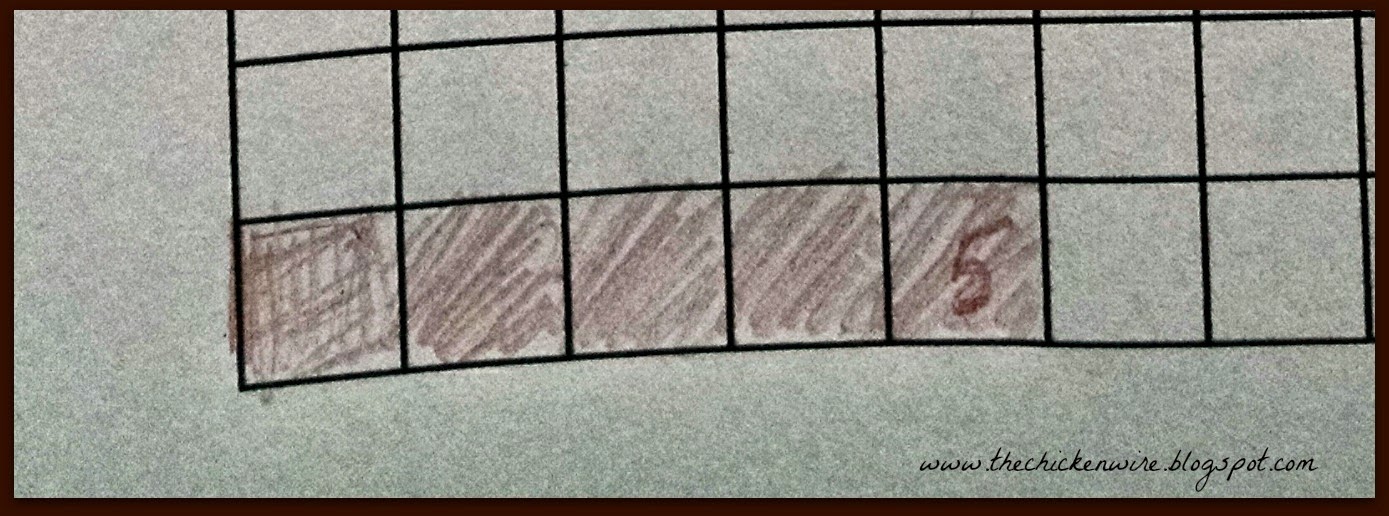
3. The child chooses a number that was rolled and makes an x (I colored mine as it made it easier when I was explaining it) on that many squares on the grid going either up or across.  Then the second number determines the amount of squares filled in going the remaining direction (up or across).  As you can see in the picture, the first number is 1, so the squares are filled in for 1 row going up.  The second number is 5, so the squares are filled in 5 across.
4. Once the child is done filling in squares, they write the product in one of the squares.


5. It is now the next child's turn to roll. You can see we chose three as the first number so three up and then 4 across.  Thus 3x4=12.


6. The game continues and the squares are filled in until the last space is filled. If one player can't fill in a space, the next player rolls and tries to fill it in. With the person filling the last spot being the winner!  As it gets down to the last few tiny spots to fill in, we set one die to the side with the number one on it and just rolled one die.  You don't have to do this but it makes the ending a little less drawn out.


Revisions to Increase Difficulty Level
As the children progress in multiplication you can:
-Use a smaller grid.
-Roll two dice for the first factor and one for the second.
-Roll two dice and add twice for the factors to get big boxes.

Thanks for stopping by!  I hope you enjoy the game!  I would love to hear if your kids like it or if you have any questions. 

-

Monday, August 11, 2014

A Fun Way to Practice Flash Card Facts: Silent Flash Ball

This game was shared by my Mother-in-Law who has taught 5th grade math for 20+ years.  It is a spin-off of a game that was originally found in a book titled Multiplications and Division Flashcard Games for Grade 3-4 by Susan Dillon.  My MIL says she is amazed at how well loved this game is because it's SO simple!  But it's a great way to learn Math Facts (not just Multiplication and Division) while having fun!


So here's her version: ( I have added a revision at the bottom for those playing with only 1-2 children or multiple ages)
Materials Needed:
-A small ball that you don't mind tossing inside.
-Flash cards appropriate for what Math facts you are learning.
-Enthusiasm!

How to Play:
1. The game begins with everyone standing.
2. The person directing the game shows the first flash card.
3. Toss the ball to a person of your choice.
4.  If they drop the ball, they sit down.
5.  If they catch it, they can answer the problem on the flash card.  If they get it wrong they sit down.  If they answer correctly, it is their turn to toss the ball.
6. Show the next flash card and the student gets to toss the ball to another student.
7.  The last person standing is the winner.

Revisions for different age groups together or fewer students.
Multiple Age Groups:
-Have multiple sets of Flash Cards.  For example Addition and Subtraction, Telling Time, Money, for 1st grade.  Colors and shapes for Preschool.  Multiplication and Division for 3rd+.  Don't show a card until the ball has been thrown and consider rolling the ball to younger children.

Fewer Students
-If you are working with only 1-2 students you could try keeping score (try to score 10 pts before the ball gets dropped) or working against a timer.  The ball could be tossed back and forth between you and the student.  

I hope you enjoy this game!  Let me know if you try it out!

Wednesday, January 2, 2013

Kindergarten in Ambleside Online - Schooling on a Budget


How We (will now ) Do Kindergarten With Ambleside Online 

Well, it's the middle of our school year and the beginning of a new year and I have decided to focus our schooling only on the curriculum of Ambleside Online. I won't be going into what that entails, because there is already a ton of good information on the website, but I will be sharing some links that help us do school on a very limited budget.

I got a little sidetracked this year by thinking I needed to make our homeschool fit the idea of public school but I feel the need to get back in line with the Charlotte Mason Method. It has been such a joy and such a relief to settle ourselves into this schedule and the attitudes about school are improving on all fronts! 

Here is an article to get you started if you want more info.  And I am reading the Charlotte Mason Series in Modern English, which I highly recommend.

So this portion of my blog will help me keep the details together and hopefully it may be helpful to others who are interested in the curriculum as well.

*Notes
-I am on a strict to non-existent school budget so I will share as many links as I can to help you find free resources where available.

-I use my Kindle for a lot of the books we will read but even if you don't have one, you can download the Kindle Cloud Reader for free and take advantage of the free books available.


-We homeschool with a baby so I arranged the early part of our school day to be free of supplies(like paper,crayons,scissors) to make things easier.  I nurse him during our Bible Reading, then lay him down for a nap while the girls get out the supplies for Table Work.


What You Need:
-A Math Program -Here is a free one that we will use. I would also like to look into this program more, called Living Math
-A Phonics Program - We use Teach Your Child To Read in 100 Easy Lessons.  I paid approximately $12 for ours. We plan to continue using the Rod & Staff curriculum and they have a phonics program in first grade as well. 
-Books- Kindle or Library
-A Bible or Children's Bible Study (Don't feel like you have to buy a Bible Study.  For generations upon generations parents have been reading God's word and telling those stories to their children without outside help.
We use this system to keep track of the Verses We Are Memorizing.  I also reviewed an affordable e-book that has a lot of good ideas for teaching scripture to your children called God's Word in My Heart.
 

You can add in other things like Foreign Language, Handicrafts, Nature Study and Music Lessons as you go, if you wish. 

Our Schedule: (This is the plan, but it's not set in stone.)

Daily: (1-1 1/2 hrs)
Music(Folk Songs, Composer Study & hymn study)

Prayer&Pledge

Bible Reading & Verse Memorization -For our Bible reading we read out of a set of books called The Bible Story by Arthur S. Maxwell and we memorize a new verse each week.

Table-Work: Math & Phonics- We also use the Rod & Staff workbooks because my girls enjoy them and they are helpful in teaching the basics. You don't have to have these, but we like them and they are quite affordable.


This is an excerpt from the book Going on Eagerly in the Rod & Staff  series G-H-I

Read-Aloud: From the Ambleside Online booklist (I don't make myself crazy if I can't get all of these books.  I use what's available on Kindle for free, at the library or sometimes you can find them on YouTube.)
Here's a helpful suggestion for coming up with Narration prompts during story time.  It's called a  NarrationJar.
 -If you like, you can get Grimm's Fairy Tales free on Amazon for Kindle. If you don't have a Kindle you can download the Kindle Cloud Reader.

-Poetry: We are memorizing poems and also reading them for fun with our read-aloud time.  You can find poetry HERE and HERE  and you can read more about the benefits of reading poetry with your children HERE.
I also like to read from The Golden Books Family Treasury of Poetry selected by Louis Untermeyer each day.  Poet's Corner is a good source for finding poetry online.


-Outdoor Play/Nature Study:  This is a big part of the Charlotte Mason method.  This is a great website for ideas and guidance- Handbook of Nature Study.
You can read the Handbook of Nature Study here.  

This is my Kindergartener's Nature Journal.  We found male and female pinecones but the male cone was falling apart and she sort of help it along with that ;)  so we didn't bring it inside.
-We go to Co-op on Thursday so we don't plan anything else for that day.  If you don't attend a co-op I recommend taking a day, usually Friday as a day to catch up on anything you weren't able to get to during the week or just use the empty day to do fun activities like board games or crafts.  So schedule things light for that day.

If you decide to add in some extras:
We like to participate in a weekly activity called Sketch Tuesday.  There is a subject given to inspire a sketch and you send it in and it's included with a slide-show of other drawings.  I really like her blog for Art suggestions as well and she has Charlotte Mason High School info too, if you have older children.

-I'm planning to start doing Summer Sewing School, a neat idea I saw at the SchneiderPeeps blog.  We will learn Handicrafts during the summer instead of during the school year.  For me this helps alleviate the feeling of guilt from not always getting to it during the afternoons and allows us to keep some structure during the summer break.  

 -Music & Composer Study
I found a bunch of neat websites that look like they would be fun to use for Music Lessons if you can't afford real lessons and to supplement Composer Studies
http://pinterest.com/mtkatrina/charlotte-mason-homeschool/ Lots of ideas on my Pinterest page for Composer study and school in general
http://www.dariamusic.com/ -Music Around the World
http://www.pbs.org/wgbh/fromthetop/video/season-2/-PBS Television show that highlights young musicians
http://www.homeworkspot.com/theme/classicalmusic.htm Classical Music
http://www.musictheory.net/ Learn Music Theory
http://www.foriero.com/  games for children, you can learn how to play the piano, learn notes and tones, practice the memory and train the ear.
http://www.sfskids.org/templates/home.asp?pageid=1 San Francisco Symphony website, has learning games.
http://datadragon.com/education/reading/ Learn to read music.

-We follow this Composer Study schedule from Homegrown Learners:
http://homegrownlearners.squarespace.com/storage/A%20Composer%20a%20Month.pdf
-She also has a great article to read regarding music and composer study.
http://www.homegrownlearners.com/home/2012/12/27/5-easy-ways-to-incorporate-music-in-2013.html


There are a few things I haven't managed to cram into our schedule and I'm still deciding if/where they fit.  I may be tweeking our schedule as we go, but I'm pretty happy with this schedule.  It is simple yet well-rounded.  Also, we will not necessarily have built in crafts or games but I have supplies where they can reach them and try to encourage them to color, draw and play during their free time.Some of the activities will naturally encourage drawing and crafting anyway so I didn't feel the need to add more.  We like to play board games in the afternoon as well so I didn't add those to the school schedule.

I would love to hear any ideas or suggestions you might have for me!


Monday, October 29, 2012

Morning Meeting Binder a.k.a. Morning Circle, Morning Board, etc...


Morning Meeting Binder
 Making a Calendar Time Binder on a  Budget

*Note: this is a super simple version and the pictures are very grainy for some reason... But such is life.
This past summer when I was in the planning stages of our Kindergarten year of homeschool, I came across some fantastic ideas for a Morning Board.  The women who put these together had amazing set-ups.  Big calendars and boards and print outs!  I loved them all.  But in order to apply it to my life I had to do things a little simpler and with what I had on hand.  First of all I don't have a printer, so I used a little creativity and drew my own. And I didn't have the funds to buy new supplies for a calendar and clips, etc... So I use a whiteboard calendar that we already had.  It's not a fancy set up, but it's functional and keeps me on track.  This is probably my most used tool that I use in homeschooling.  I'd be sort of lost without it.  So without further ado, here is the description of my Morning Meeting binder.

Making the Binder:
Supplies:
Binder
White Paper
Markers
Page Protectors
Dry Erase Marker

Directions:
In order to make each page, I took a plain white sheet of paper and neatly wrote the title of that page.  Then I placed it in a page protector and put the page in the binder.  Then all I have to do is write on the page protector with my dry erase marker!

Daily List:
This is just a checklist of the things we are going to cover each day in Morning Meeting.  The parts that don't have a corresponding page are:
-Calendar: My five year old and I review the Month, Day, and Year and update the date on the whiteboard calendar.  And then we all sing a Months of the Year and Days of the Week song.  We don't sing the songs every day.  Maybe once or twice a week...
- The Weather: We are making a weather wheel in school today and I'll link to that later, but at this point I just have them draw the weather on our white board calendar.  
-Memory Verse- I have a basket for our index cards and use THIS memorization system.
-Pledge of Allegiance and Prayer:  I think this is self-explanatory.
 -I have a reminder to have the girls write their names at the end of every month as it's fun to measure improvements in handwriting from month to month. 
-I will be adding in a page for setting the time on a paper clock, once we cover that in school.


Days in School
My five year old fills in the number of days we have been in school and we are planning a fun day for the 100th day of School! 


Address & Phone Numbers
I don't have pictures of these, well, because they had our address and phone number on them : )  But we do have them and we recite them every morning.

Foreign Language
We are learning German, so each weekend I choose a word or phrase that we will learn and use for the week.  The one pictured is a bedtime prayer.  I also keep a record in the back of the binder of the words we have learned in order to review.  It looks a little messy but I have notes on what numbers we are learning as well. 


Good Manners/Habits:
I choose these based on the improvements I would like to see in my and my children's life.  For example, we have done Orderliness, Asking Permission and will be working on Generosity.  I sometimes use the same one for more than a week as needed.  

Letter of the Week:
This is more geared towards my 3 year old.  (Her schooling is pretty relaxed as I don't think she needs to start this early but she wanted to be involved and it helps keep her occupied to give her some special activities.)  We don't do letter names right now, we do letter sounds.  We also work on the Sign Language Version of the letter.  So every morning I hold up the page and she makes the sound and then we sign all of the letters that we know.  I think just learning the letter sounds helps her with her word enunciation as well.  
I hang the letter of the week up on our wall as well, it's a letter-sized piece of paper with the letter on it and a picture and I put the Sign Language flash card underneath it.  You can find a fun printable of the letter and the sign here

Sight Word:
I threw this one on a couple of weeks ago and haven't even bothered to give it a title... This is my five year old's Sight Word of the Week.  I either get it from the ABCJesusLovesMe site or from the book Teach Your Child To Read In 100 Easy Lessons 


And that's it!  I update it when I plan school on the weekend and it's the first thing we use every morning!  I think the routine of it helps my kids get into a school mind-set and it makes it easy to remember all of the things we need to be going over on a daily basis.
As far as planning the rest of our school day I use www.homeschoolskedtrack.com 
It allows me to enter in our lesson plans, track attendance and record all of the books we read.  I recommend watching the tutorials if you are going to use it as it could get confusing otherwise.  But once you get the hang of it, it's pretty easy.  And it's free!